

April 16, 2026
How Anthropic Accidentally Leaked 500,000 Lines of Code
And What It Means for Every Enterprise Using AI
Crodox • 5 min read
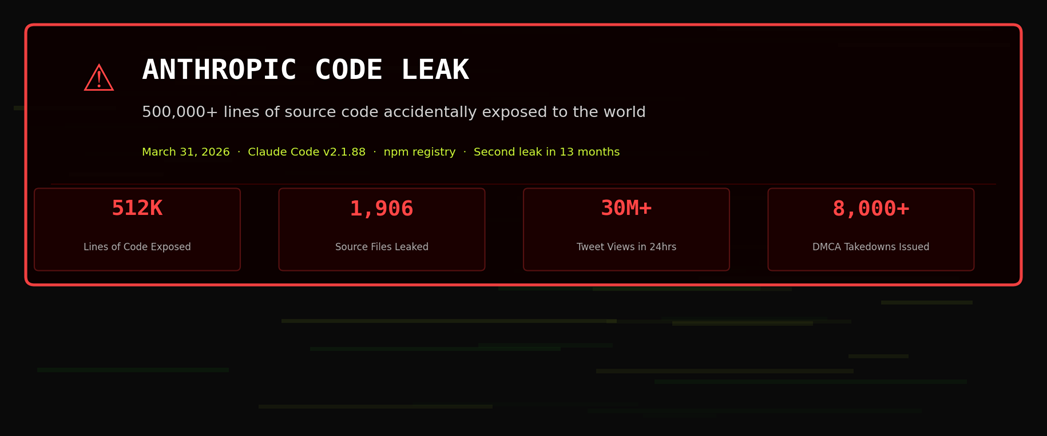
On March 31, 2026, Anthropic, one of the world's leading AI safety companies and the creator of Claude, accidentally published a portion of internal code of its flagship product, Claude Code, to a public npm registry. Over 512,000 lines of proprietary TypeScript across nearly 2,000 files were exposed. Within hours, the code was mirrored, dissected, rewritten in Python and Rust, and studied by tens of thousands of developers.
Anthropic called it "a release packaging issue caused by human error, not a security breach." That's technically accurate, it obscures far more significant, strategic, and operational problems.
What Actually Happened
The culprit was a JavaScript source map file, a debugging artifact that developers use internally, accidentally bundled into a public release of Claude Code version 2.1.88. That file pointed to a zip archive hosted on Anthropic's own cloud storage, containing significant parts of the client-side agent logic behind Claude Code.
What was exposed:
- Complete orchestration and agent logic - how Claude Code manages long-running tasks
- Memory management system and context handling across complex sessions
- Feature flags for dozens of unreleased capabilities, fully built but not yet shipped
- Internal model codenames (Capybara, Mythos, Fennec) and performance metrics
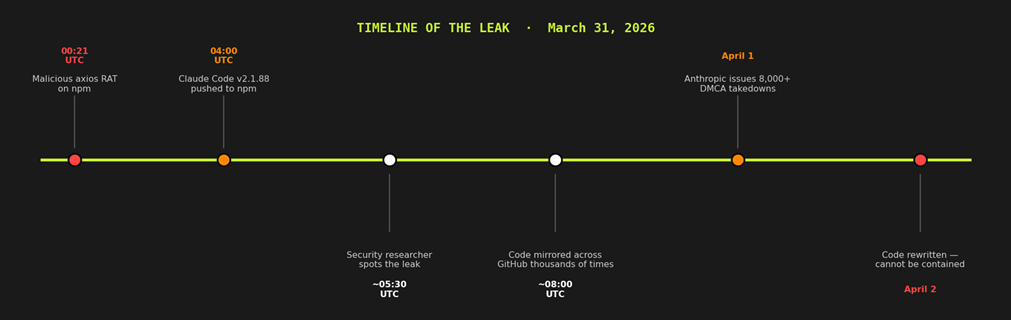
Security researcher Chaofan Shou spotted it almost immediately and posted about it publicly. The tweet was viewed over 30 million times. By the time Anthropic issued takedowns, the code had already been mirrored into thousands of repositories. The company eventually issued over 8,000 copyright takedown requests, some of which hit legitimate forks by mistake, forcing an embarrassing partial rollback.
To make matters worse, the leak coincided almost exactly with a separate, unrelated supply chain attack on the axios npm package - meaning developers who updated Claude Code during a specific three-hour window may have also inadvertently installed a Remote Access Trojan.
Why This Matters Beyond Anthropic
It would be easy to treat this as an Anthropic-specific story - a cautionary tale about one company moving too fast. But that reading is dangerously comfortable.
The real lesson is universal. It cuts to the heart of what happens when AI tools are given broad, ungoverned access to your codebase.
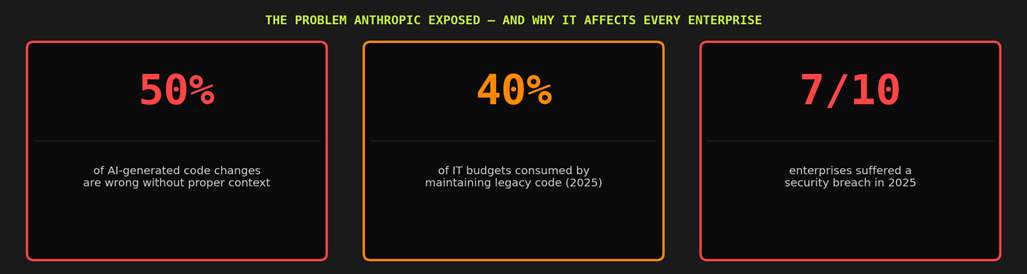
Claude Code, like all modern AI coding agents, works by taking in large amounts of code context and using it to generate, modify, and deploy changes. The more context it has, the better it performs. But that same breadth of access - which makes the tool powerful - is precisely what makes a packaging mishap this catastrophic.
Now ask yourself: what would the equivalent look like inside your organization?
Your AI coding tools have access to:
- Your entire codebase, including internal APIs and business logic
- Your unreleased product roadmap, embedded in code comments and feature flags
- Your performance metrics and internal model benchmarks
- Your security architecture and access control logic
All of it is sitting there, accessible, because that's how these tools are designed to work. When the release process fails - as human processes inevitably do - there is nothing to contain the blast radius.
How Crodox Would Have Prevented This
This is precisely the problem Crodox was built to solve.
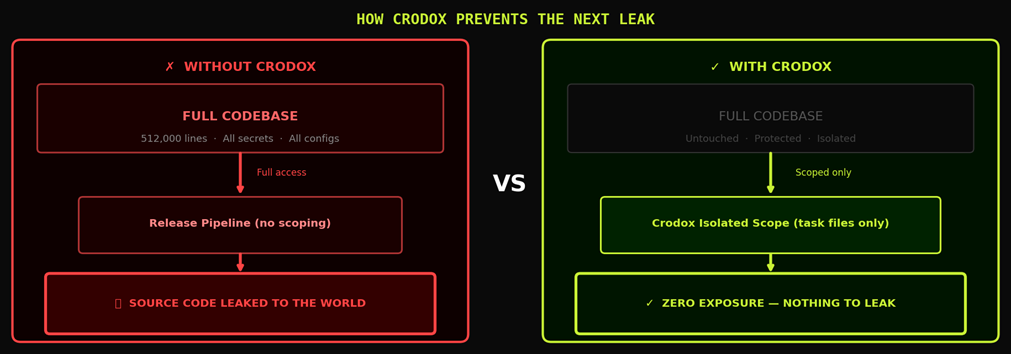
At the core of the Crodox platform is code isolation per change. Instead of giving AI agents - or any developer, internal or external - access to the full codebase, Crodox automatically extracts only the specific code relevant to a given task, including all its dependencies, across languages.
Applied to the Anthropic scenario: if Claude Code's release pipeline had been running through Crodox, the packaging process would have operated on a scoped, controlled extract of the relevant release files - not the full source tree. The debugging source map would never have been in scope. It wouldn't have been accessible. It couldn't have leaked.
Crodox delivers three core protections:
- Code Isolation per Change - AI agents and pipelines only see what's relevant to the task at hand
- Governed Development Scopes - humans and AI work in controlled environments, never the full codebase
- Safe Reintegration - validated changes are automatically merged back, with no manual shortcuts possible
The Bigger Picture
Anthropic is not a careless company. They are, by most accounts, one of the most safety-conscious organisations in the AI industry. And yet they have now leaked parts of their own source code twice, exposed a confidential model roadmap, and accidentally nuked thousands of GitHub repositories, all within a matter of weeks.
If it can happen to them, it can happen to anyone.
The uncomfortable truth is that AI coding tools fundamentally change the risk profile of software development. They're powerful precisely because they operate with broad access and high autonomy. But that power comes with a corresponding responsibility to govern that access carefully.
The AI coding wave is here. The question isn't whether you'll use these tools - you will, or your competitors will. The question is whether you'll build the infrastructure to use them safely.
That infrastructure is what Crodox provides.